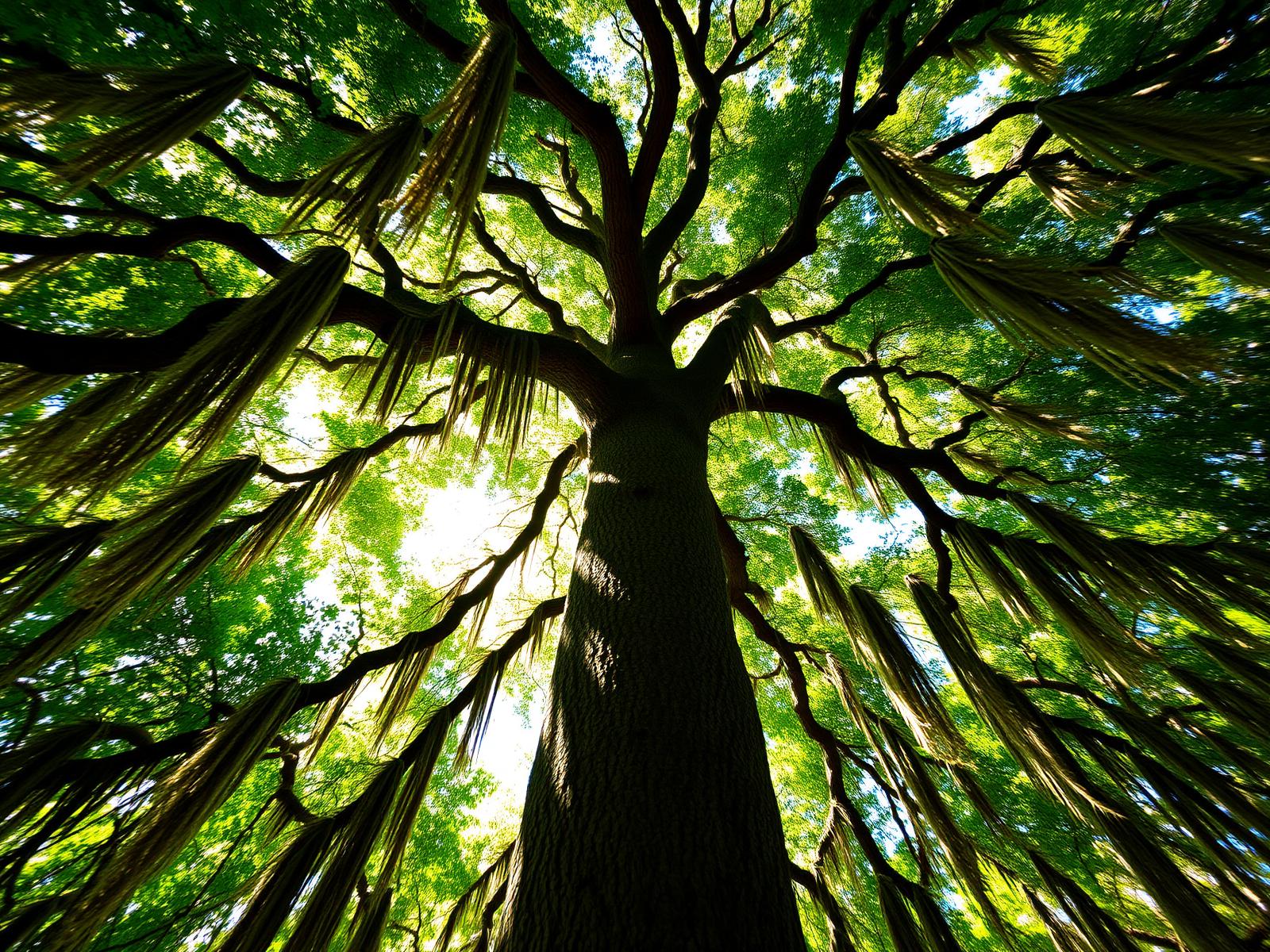
The image is iconic: hurricane footage, palm trees bent nearly horizontal, fronds whipping, trunk arched and somehow not breaking. The conclusion most people draw — palms survive hurricanes because they bend — is roughly true, but the engineering and biology are more interesting than the slogan, and the conditions that do kill palms in storms are the ones most homeowners are inadvertently creating.
Why palms bend
A palm is not a tree. It is a monocot — closer botanically to grasses and lilies than to oaks. Its trunk is not made of concentric annual rings of woody xylem; it is a bundle of vascular fibers embedded in a softer parenchyma matrix. The whole structure functions as a flexible composite, more like a fiberglass rod than a steel beam.
Under wind load, a palm trunk deflects elastically — it bends, stores the energy, and releases it when the gust passes. A live oak limb, in contrast, is rigid until it isn't; once the bending stress exceeds the wood's modulus of rupture, it snaps. This difference is why palms can survive sustained winds that destroy hardwood canopies.
The crown is everything
The palm trunk is engineered for wind. The crown — the cluster of fronds at the top — is the part that fails. A healthy palm's crown has 20–40 mature fronds arranged in a roughly spherical shape that streamlines into the wind. The fronds themselves are designed to fold and feather; they reduce the effective sail area as wind speed increases.
When the crown is damaged, removed, or thinned excessively, two things go wrong. First, the streamlining is lost — wind catches the asymmetric, unbalanced canopy and applies twisting loads the trunk was not engineered for. Second, the meristem (the single growing point at the apex) becomes exposed to mechanical damage and pathogen entry. A palm has exactly one growing point. Lose it and the tree is dead — there is no possibility of replacement growth.
Why the 'hurricane cut' makes palms more likely to fail
The hurricane cut — removing all but a vertical tuft of new fronds, leaving the canopy looking like a feather duster — is sold as storm preparation. It does the opposite. The remaining vertical fronds catch wind like a sail; the missing horizontal and pendant fronds were the ones doing the streamlining. Crown reduction also removes the photosynthetic capacity the palm needs to defend itself against the next year's pests and pathogens, particularly potassium deficiency and Lethal Bronzing.
Multiple Florida municipalities have responded by criminalizing it. Sarasota County, Lee County, and the cities of Naples, Marco Island, Sanibel, Captiva, and Fort Myers Beach all carry fines for the hurricane cut on protected species.
When palms actually fail in storms
- Root plate failure — palms have shallow, fibrous root systems concentrated within 18 inches of the trunk. In saturated soil with sustained 100+ mph winds, the entire root plate can lift, and the palm topples intact. This is more common in recently planted palms (under 3 years), and palms growing in compacted urban soils that limit root extension.
- Crown loss — direct impact from windborne debris can shear the crown. The trunk survives but the meristem is destroyed.
- Trunk snap above a wound — palms cannot compartmentalize wounds (no cambium, no callus tissue). A nail hole, a chainsaw nick, or a lightning strike creates a permanent weakness that can snap in a Cat 3 wind decades later.
- Disease-weakened trunk — Ganoderma butt rot (Ganoderma zonatum) hollows the base of the trunk silently. The tree looks healthy until the day it falls. There is no cure; affected trees should be removed before hurricane season.
Species that handle storms best
- Sabal palmetto (cabbage palm) — Florida's native, evolved for hurricanes. Most resilient.
- Roystonea regia (royal palm) — flexible, fast-growing, generally storm-tolerant. South Florida only.
- Phoenix dactylifera (date palm) — heavy and dense; root plate failure is the typical failure mode.
- Cocos nucifera (coconut) — handles wind well, vulnerable to Lethal Yellowing and crown loss from coconuts as projectiles.
Species that handle storms worst
- Washingtonia robusta (Mexican fan palm) — tall, thin, often planted in narrow medians; trunk snap above wounds is common.
- Recently transplanted palms of any species — three years from planting to full root re-establishment.
- Palms with active Ganoderma — any palm with conks at the base is a tomorrow problem.
What we recommend before hurricane season
Inspect the trunk base for Ganoderma conks (shelf-like fungal fruiting bodies, brown on top and white below). Remove only dead fronds — leave anything green and above horizontal. Verify the palm is not planted within 10 feet of the house if you can avoid it; many residential palm failures damage roofs simply because of placement. And do not, under any circumstances, accept the hurricane cut from anyone who shows up with a chainsaw and a quote.